Why Every Enterprise Needs an AI Strategy Before Competitors Build Theirs
Organizations without a deliberate AI strategy are not standing still — they are actively falling behind. Here is the framework I use to help enterprises build theirs.
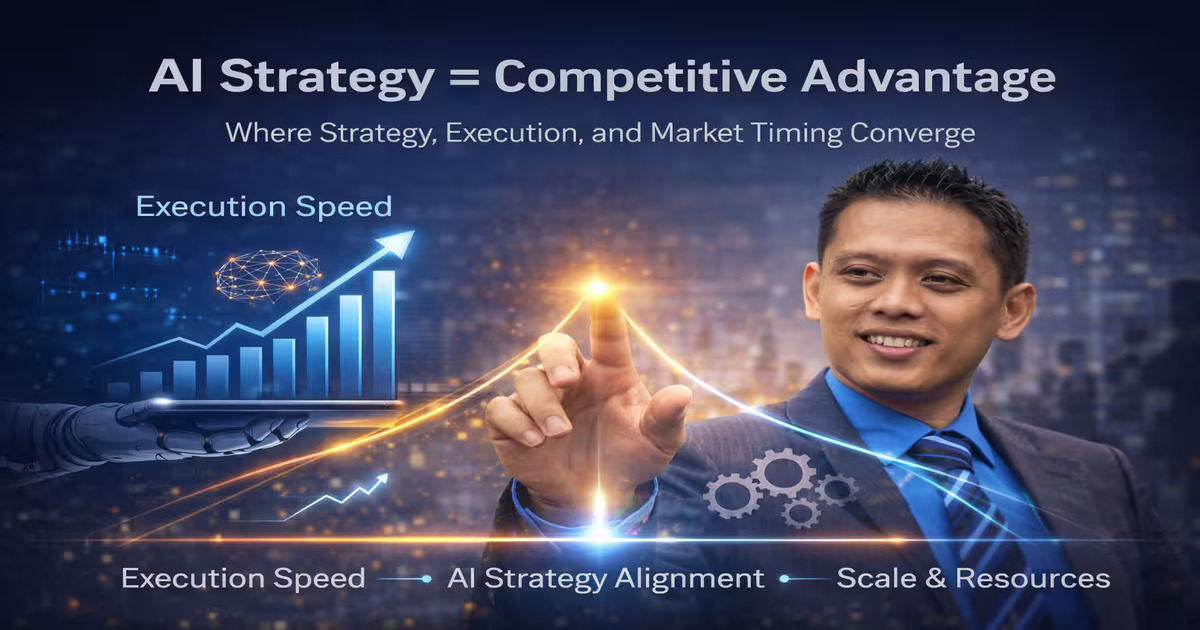

The AI Strategy Gap Is Widening
Every board meeting I attend in 2026 starts with the same question: where are we on AI? The uncomfortable truth is that most enterprises still lack a coherent AI strategy. They have experiments, proofs of concept, and innovation labs — but not a strategy.
After leading AI transformation across mining, insurance, media, and financial services, I have seen what separates organizations that capture AI value from those that merely talk about it.
What an AI Strategy Actually Looks Like
An AI strategy is not a list of use cases. It is a deliberate alignment between your organization's competitive positioning and the specific AI capabilities that will create defensible advantage.
The three pillars I use in every engagement:
1. Value Architecture — Map every revenue stream and cost center against AI opportunity. Prioritize ruthlessly. The best AI strategies focus on three to five high-impact domains, not fifty scattered experiments.
2. Capability Stack — Define what you build, what you buy, and what you partner for. Most enterprises should not train foundation models. But every enterprise needs proprietary data pipelines and domain-specific fine-tuning capability.
3. Operating Model — AI is not a project. It is a capability. You need an operating model that embeds AI into business-as-usual decision making, not a separate innovation team that delivers demos nobody adopts.
The Competitive Clock Is Ticking
In financial services, AI-native insurtech companies are underwriting risk with models that update hourly. In mining, predictive maintenance algorithms are reducing downtime by 40 percent. In media, AI-driven content recommendation engines are capturing audience attention at scale.
If your competitors are building these capabilities and you are still debating whether to hire a Chief AI Officer, the gap is already significant.
Start With These Three Questions
First, which decisions in your organization would be dramatically better with real-time predictive intelligence? Second, where is your proprietary data advantage — the information you have that competitors cannot easily replicate? Third, what is the cost of waiting another twelve months?
The enterprises that win with AI are not the ones with the biggest budgets. They are the ones that start with clarity about where AI creates asymmetric advantage — and then execute relentlessly.
Share this article
Related Articles
The CTO's Playbook for Deploying Large Language Models at Enterprise Scale
Deploying LLMs in enterprise is fundamentally different from building a ChatGPT wrapper. Here is the architecture and governance framework I have refined across multiple deployments.
Generative AI ROI: How to Measure What Actually Matters
Most organizations cannot quantify their generative AI investments. Here is the measurement framework I use to prove — and improve — AI ROI across the enterprise.
RAG vs Fine-Tuning: Choosing the Right Approach for Your Enterprise LLM
The RAG vs fine-tuning debate is the most common architectural question I get from enterprise teams. Here is my decision framework based on real-world deployments.